
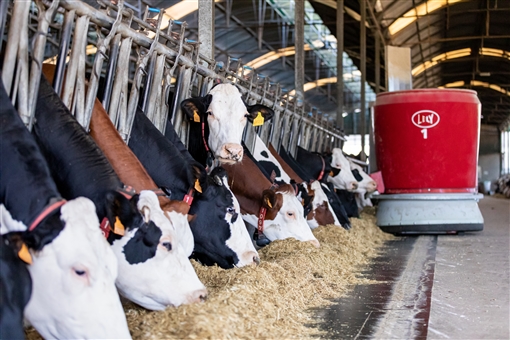

Feed efficiency – the magic number showing how well cows convert feed into milk – has become a hot topic for dairy farmers aiming to boost productivity, sustainability, and profitability. But what really drives this number, and how can farms use it as a practical management tool?
At its core, feed efficiency is energy-corrected milk divided by dry matter intake (ECM/DMI). In simple terms, it measures how much milk a cow produces relative to the feed she consumes. But don’t be fooled – behind this simple ratio lies a complex interplay of biology, nutrition, management, and genetics.
1️⃣ Lactation Stage Matters
A cow’s energy priorities shift throughout lactation:
-
Early lactation: Cows are often in negative energy balance, drawing on body reserves (primarily fat) to support milk production. This “borrowed energy” can make feed efficiency numbers look higher than they really are.
-
Mid to late lactation: Energy is diverted toward pregnancy and restoring body condition. First-lactation heifers also use energy for growth. In these cases, feed efficiency may appear lower because energy spent on these important non-milk functions isn’t counted in ECM/DMI.
Understanding these shifts is key for realistic benchmarking and setting farm goals.
2️⃣ Feed Formulation & Digestibility
Feed efficiency improves when cows extract more nutrients from the same amount of feed. Factors include:
-
Forage quality: Timing of harvest, processing, and hygiene can make a big difference.
-
Ration digestibility: Highly digestible feeds support nutrient absorption and milk production.
-
Feed intake vs. efficiency: While more digestible rations often increase intake (slightly reducing digestibility), the net effect usually improves economic efficiency if milk production rises accordingly.
In other words, smart feeding pays off – a well-formulated ration is like giving cows the best possible “fuel” for milk production.
3️⃣ Stress & Management
Even the best ration can’t overcome stress. Feed efficiency drops when cows burn energy on:
-
Immune responses to disease
-
Heat stress or cold stress
-
Competition for feed or lying space
-
Excessive walking or standing
Minimizing stress and improving comfort (like well-designed barns and robotic milking systems) helps cows use energy for milk, not unnecessary survival efforts.
4️⃣ Genetics
Genetics also play a role in feed efficiency:
-
Residual feed intake (RFI): Measures how much a cow eats relative to expected intake for her size, production, and growth.
-
Breeding programs increasingly include RFI and other efficiency-related traits.
-
Variations in rumen microbes, nutrient partitioning, and metabolism mean some cows naturally convert feed to milk more efficiently than others.
While we don’t fully understand all genetic mechanisms yet, breeders and farmers can leverage these insights to improve herd-level efficiency over time.
Typical Feed Efficiency Ranges
Cows usually fall between 1.3 and 1.8 ECM/DMI, depending on lactation stage. First-lactation heifers are often slightly lower than mature cows. These numbers provide a benchmark but remember; feed efficiency alone doesn’t tell the full story – it must be interpreted alongside health, reproduction, and overall farm management.
Takeaways
-
Feed efficiency is influenced by nutrition, management, and genetics – no single factor controls it.
-
Monitor lactation stage when evaluating ECM/DMI to avoid misleading conclusions.
-
High-quality, digestible feed combined with low-stress housing and robotic milking can significantly boost efficiency.
-
Genetics matter – consider RFI and other traits in breeding programs.
By understanding what shapes feed efficiency, Lely farmers can make smarter management decisions, optimize cow performance, and ultimately improve farm profitability. After all, every drop of milk counts!
Article by: Katelyn Goldsmith, Link: What Shapes Feed Efficiency in Dairy Cows? - Dairy Herd Management
-

Jamilyn Lokken
-
Cancel
-
Vote Up
0
Vote Down
-
-
Sign in to reply
-
More
-
Cancel
Comment-

Jamilyn Lokken
-
Cancel
-
Vote Up
0
Vote Down
-
-
Sign in to reply
-
More
-
Cancel
Children